Flexor Hallucis Longus (FHL) Tendon Transfer

What is an FHL Tendon Transfer?
A Flexor Hallucis Longus (FHL) tendon transfer is a surgical procedure used to reconstruct the Achilles tendon when it has been severely damaged. This is most commonly required in patients with longstanding Achilles tendon ruptures that have failed to heal, neglected ruptures, or following a failed previous Achilles tendon repair.
The FHL tendon is one of the deep tendons that runs behind the ankle before travelling underneath the foot to the big toe. It works alongside the Achilles tendon during walking and is particularly active when pushing off during each step.
Because the FHL muscle performs a very similar function to the Achilles tendon and lies immediately adjacent to it, it is an ideal tendon to use when reconstructing a deficient Achilles. It is the second strongest muscle in the calf after the gastrocnemius-soleus complex, and foot and ankle surgeons often refer to it as “beef to the heel” because it provides a powerful, living muscle-tendon unit to replace the damaged Achilles tendon.
Why is an FHL Tendon Transfer Needed?
The commonest reason for performing an FHL tendon transfer is following an Achilles tendon rupture that has failed to heal satisfactorily, either after surgical repair or non-operative treatment. In these situations, the tendon may remain elongated, weak or re-rupture, resulting in persistent weakness, pain and difficulty walking.
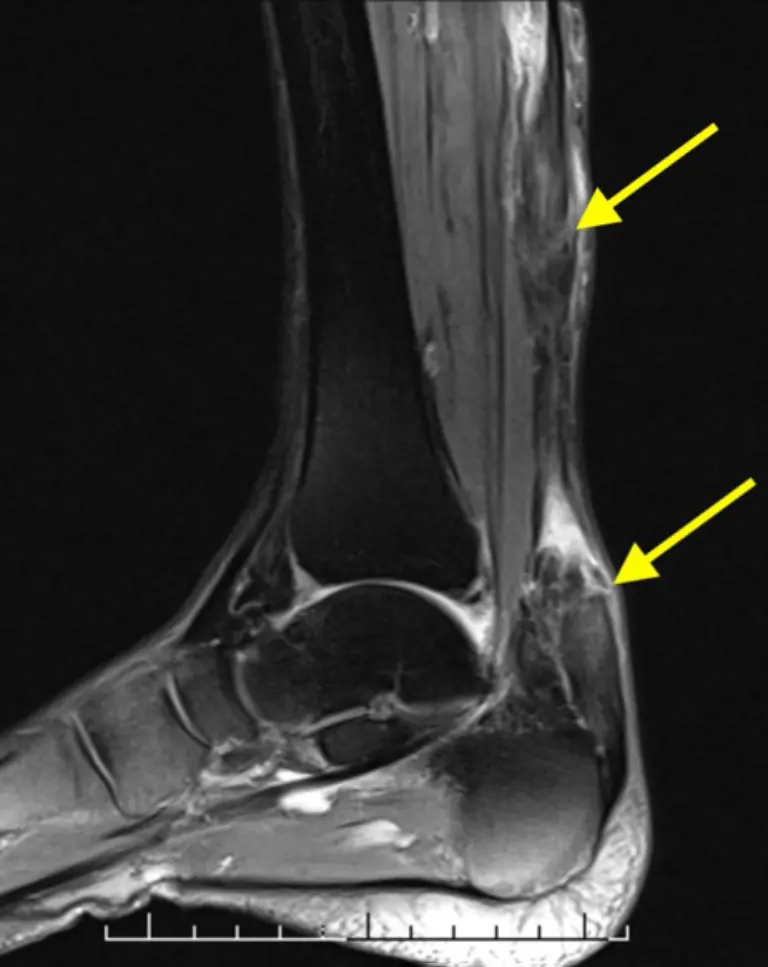
Yellow arrows at top and bottom ends of an un-noticed Achilles rupture after several weeks
An FHL transfer is also commonly performed when an Achilles rupture was not recognised at the time of injury. By the time the diagnosis is made, the tendon ends have often retracted or healed in a lengthened position, making a direct repair impossible.
Less commonly, an FHL tendon transfer is used in patients with severe, longstanding Achilles tendinopathy where so much diseased tendon must be removed that the remaining Achilles tendon is no longer strong enough to function reliably.
Will I Notice Any Difference in My Big Toe?
This is one of the commonest concerns patients have.
Although the FHL tendon normally bends the tip of the big toe, several other muscles continue to move the toe after surgery. Most patients notice little or no functional difference in everyday activities.
The vast majority of patients walk normally, climb stairs, drive and return to recreational activities without being aware that the tendon has been transferred. Elite dancers, climbers or professional athletes who place exceptional demands on the big toe may notice a small reduction in push-off strength, but this is uncommon in routine daily life.
How is the Operation Performed?
There are two main techniques for performing an FHL tendon transfer: a short FHL transfer and a long FHL transfer.
Short FHL Transfer
A short FHL transfer is the more commonly performed operation. It is technically less demanding and involves less extensive surgery.
The FHL tendon is divided behind the ankle, where it is easily accessible, and transferred directly into the heel bone. It is then secured with a strong fixation device so that the FHL muscle takes over much of the function of the damaged Achilles tendon.
Although the FHL is not as powerful as the normal Achilles muscle-tendon unit, it provides excellent function for everyday activities and allows most patients to walk comfortably again. However, because only the FHL muscle powers the reconstruction, there is usually a permanent reduction in calf strength, particularly during more demanding activities such as running and jumping.
Long FHL Transfer
A long FHL transfer is a more complex reconstruction designed to maximise strength.
Rather than dividing the tendon behind the ankle, the FHL tendon is released from its furthest attachment beneath the big toe. The tendon is then passed through the heel bone before being woven back into the Achilles tendon and muscle at the calf. This reconstructs the continuity between the calf muscles and the heel while also incorporating the powerful FHL muscle into the repair.
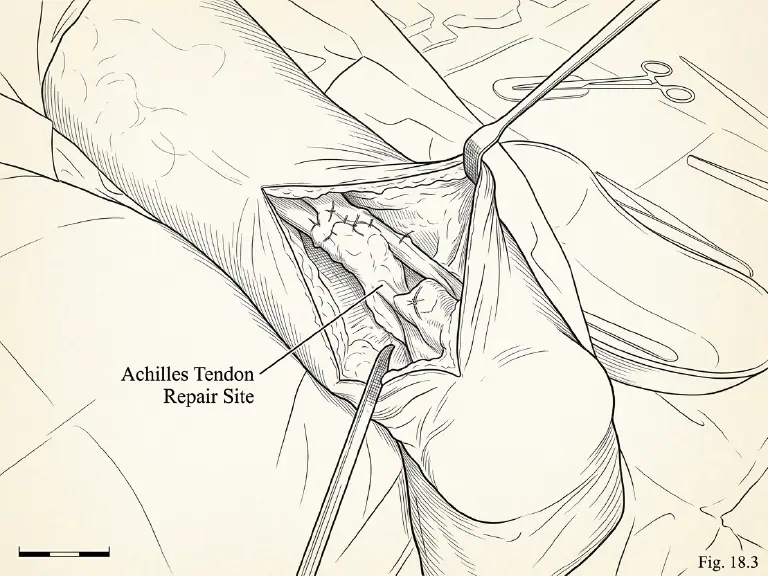
Although it is a more extensive procedure, it provides significantly greater strength than a short transfer and offers a much better chance of returning to higher levels of recreational sport and other demanding activities.
The choice between a short and long transfer depends on the size of the tendon defect, the quality of the remaining Achilles tendon, the patient’s age, activity level and goals of surgery.
Recovery After Surgery
Recovery following an FHL tendon transfer is often quicker than after a standard Achilles tendon repair. This is because the transferred tendon is securely fixed into the heel bone, and there is no need to wait for two torn Achilles tendon ends to heal together.
Initially, the leg is protected in a plaster cast. During the first two weeks, the most important part of the recovery is strict leg elevation to minimise swelling and reduce the risk of wound problems and infection. Although infection is uncommon, it can be a devastating complication following Achilles surgery, making careful attention to elevation particularly important.
At two weeks, the plaster cast is removed and patients are allowed to walk fully weight-bearing in a protective walking boot. The boot is worn for a total of six weeks, after which normal footwear is gradually reintroduced under the guidance of the physiotherapy team.
Rehabilitation then follows the same principles as an Achilles tendon repair, focusing on restoring ankle movement, rebuilding calf strength and gradually returning to normal activities. Because the tendon transfer is securely fixed the rehabilitation can be accelerated and recovery is typically around half the duration of a standard Achilles tendon repair.
Achilles Tendon Repair Rehabilitation
Most patients are walking comfortably within a few weeks, although rebuilding calf strength takes considerably longer. Strength and endurance continue to improve for many months, and the final result may not be apparent until 9–12 months after surgery.
What Are the Risks?
As with any operation, complications can occur, although most patients recover without significant problems.
Potential complications include:
- Infection.
- Wound healing problems.
- Blood clots.
- Injury to nearby nerves causing numbness around the foot or ankle.
- Persistent pain or swelling.
- Failure of the tendon to heal satisfactorily.
- Weakness of calf strength.
- Reduced strength when bending the big toe.
- Re-rupture or failure of the reconstruction.
- Complex Regional Pain Syndrome (CRPS), although this is uncommon.
Expected Results
FHL tendon transfer is a well-established and reliable technique with a high rate of patient satisfaction.
The aim of surgery is to reduce pain, restore strength and improve walking. Most patients regain excellent day-to-day function and are able to return to an active lifestyle. Recovery is gradual, however, and maximum improvement is often not seen until 9–12 months after surgery.
Patient Experience
You performed an Achilles replacement with my FHL a couple of years ago... Thought you might like to see the results after a lot of strength building. 60 mile hike along the South West Coastal Path with 20kg on my back...

Thank you for your brilliant work. You've made a huge positive impact on my life.
Mr JH 2026